Recent Posts

This is default featured slide 1 title

Go to Blogger edit html and find these sentences.Now replace these sentences with your own descriptions.

This is default featured slide 2 title

Go to Blogger edit html and find these sentences.Now replace these sentences with your own descriptions.

This is default featured slide 3 title

Go to Blogger edit html and find these sentences.Now replace these sentences with your own descriptions.

This is default featured slide 4 title

Go to Blogger edit html and find these sentences.Now replace these sentences with your own descriptions.

This is default featured slide 5 title

Go to Blogger edit html and find these sentences.Now replace these sentences with your own descriptions.

الخميس، 7 يوليو 2016

Former Lobo Frerichs earns spot on U.S. Olympic team


yan Kang)

EUGENE, Ore. — Former Lobo and NCAA record holder Courtney Frerichs ran her way onto the U.S. Olympic team on Thursday night, taking second place in the 3,000-meter steeplechase.
Frerichs clocked a personal best time of 9:20.29.
“This year couldn’t have gone more perfect,” Frerichs said in a post-race interview broadcast on NBC Sports Network.
Check back later online and in Friday’s Journal for more on this article.

White people are aging the U.S. population


The most common age for white people is decades older than the most common age among minorities, according to Census Bureau data.
In 2015, more white Americans were 55 years old than any other age, according to a Pew analysis of the census data released Thursday. For comparison, among all racial groups, 24-year-olds outnumbered every other age, Pew reported.
The most common age for every minority group was younger than that of whites by several years: Blacks’ most common age was 24, Asians’ most common age was 33 and Hispanics’ most common age was 8.
The numbers reinforce the growing diversity of the American population. According to 2015 Census data, minority babies now also outnumber white babies by a fraction of a percent.
The median age for whites, 43, was also older than the median age for the total U.S. population, which is 37. Minorities as a whole had a median age more than a decade younger than whites: 31.
The bubble of older white Americans, according to Pew, is largely attributable to the “baby boom” after World War II that gave the generation its name. Baby Boomers outnumber Millennials among whites — a trend that is reversed in every minority group.
The largest share of people in every other group aside from white Americans belonged to the Millennial generation, Census Bureau data indicated. Non-Hispanic whites composed 61.6 percent of the U.S. population in 2015, and the largest slice — 27 percent — were identified as Baby Boomers, aged 51 to 69, according to the data. In comparison, 56 percent of minorities were 34 or younger.
The youngest group of all was multiracial Americans, of which nearly half were underage and which overall had a median age of 19. The most common age for multiracial Americans was also as youthful as possible: more multiracial Americans were 0 than any other age.

Read more here: http://www.mcclatchydc.com/news/nation-world/national/article88162727.html#storylink=cpy

Do You Own Your Own Fingerprints?


These days, many of us regularly feed pieces of ourselves into machines for convenience and security. Our fingerprints unlock our smartphones, and companies are experimenting with more novel biometric markers—voice, heartbeat, grip—as ID for banking and other transactions. But there are almost no laws in place to control how companies use such information. Nor is it clear what rights people have to protect scans of their retinas or the contours of their face from cataloging by the private sector.
There’s one place where people seeking privacy protections can turn: the courts. A series of plaintiffs are suing tech giants, including Facebook and Google, under a little-used Illinois law. The Biometric Information Privacy Act, passed in 2008, is one of the only statutes in the U.S. that sets limits on the ways companies can handle data such as fingerprints, voiceprints, and retinal scans. At least four of the suits filed under BIPA are moving forward. “These cases are important to scope out the existing law, perhaps point out places where the law could be improved, and set principles that other states might follow,” says Jeffrey Neuburger, a partner at law firm Proskauer Rose.
The bankruptcy of fingerprint-scanning company Pay By Touch spurred BIPA’s passage. Hundreds of Illinois grocery stores and gas stations used its technology, allowing customers to pay with the tap of a finger. As the bankrupt company proposed selling its database, the Illinois chapter of the American Civil Liberties Union drafted what became BIPA, and the bill passed with little corporate opposition, says Mary Dixon, legislative director of the Illinois ACLU.
Under the Illinois law, companies must obtain written consent from customers before collecting their biometric data. They also must declare a point at which they’ll destroy the data, and they must not sell it. BIPA allows for damages of $5,000 per violation. “Social Security numbers, when compromised, can be changed,” the law reads. “Biometrics, however, are biologically unique to the individual; therefore, once compromised, the individual has no recourse, [and] is at heightened risk for identity theft.”
In April 2015, Chicagoan Carlo Licata, a Morgan Stanley financial adviser, sued Facebook under BIPA, arguing that the company violated his privacy by using its facial-recognition software to create a detailed geometric map of his face and tag him in photos. Two more Illinois residents filed complaints against Facebook the following month. That June a logistics engineer and paratriathlete named Brian Norberg brought an almost identical suit against the photo-sharing site Shutterfly. Two more plaintiffs sued video game publisher Take-Two Interactive Software on similar grounds in October, and two more went after Google in March. The companies declined to comment for this story.
“I think people had really imagined, well, biometrics, it’s got to be an in-person thing. You walk in front of a facial scanner,” says Mark Eisen, a lawyer at Sheppard Mullin in Chicago who specializes in consumer privacy and class-action suits. (He’s not involved in any of the cases.) “So that first lawsuit got a lot of attention, and follow-up lawsuits happened pretty quickly.” Most of the suits focus on photo tagging; in Take-Two’s case, the plaintiffs are worried about the game maker’s creation of realistic digital look-alikes using their facial profiles.
Take-Two has argued that the plaintiffs lack standing because they haven’t claimed harm. The lawsuit against Shutterfly survived a motion to dismiss in December and ended with an undisclosed settlement in April. In the Facebook suit, the plaintiffs are seeking information about, among other things, Facebook’s marketing of and third-party access to its faceprint database. Facebook is arguing that BIPA was meant to apply to physical facial scans and shouldn’t apply to photos.
The Facebook plaintiffs, whose cases have been consolidated in California, where the company is based, passed a crucial test in May. Facebook had argued that according to its terms of use, disputes should be handled under California law, which lacks BIPA-style protections for biometric data. The judge didn’t agree, ruling that BIPA applies. In a June 29 filing, Facebook made the same argument as Take-Two—that the plaintiffs lack standing to sue because they haven’t claimed harm. Google, meanwhile, is challenging BIPA as unconstitutional on the grounds that one state can’t set rules for the rest of the country.
National efforts to establish biometric guidelines haven’t gone well. In 2014 a Department of Commerce agency led an effort to develop a code of conduct for companies using facial-recognition technology, but consumer advocates withdrew from the group the following year, saying tech companies refused to consider the most modest of privacy protections. The effort yielded an unenforceable set of privacy recommendations, published in June.
Part of the problem is that government agencies often have an interest in looser consumer protections. In May the Department of Justice proposed exempting the FBI’s facial-recognition program, called Next Generation Identification, from privacy protections. In June the Government Accountability Office reported that the FBI program failed tests of accuracy and privacy. So far the report hasn’t led to any action.
In Canada and Europe, Facebook stopped offering tag suggestions on photos following pressure from regulators to obtain consent to collect people’s images. In the U.S., BIPA has become a target. Just before Memorial Day, with the Illinois legislature rushing to finish its session, Democratic state Senator Terry Link proposed an amendment to the statute that would have excluded photos and digital images from protection and neatly undercut the lawsuits. The ACLU’s Dixon says the amendment was Facebook’s doing. Link declined to comment. Following outrage from advocacy groups such as the ACLU and the Electronic Frontier Foundation (EFF), it was shelved without a vote, but there’s nothing stopping its reintroduction.

“This measure was introduced right before the Memorial Day weekend and could have been passed and changed the law over that weekend,” says Jennifer Lynch, a senior staff attorney at EFF. “If we only have one state with a law that protects use from commercial biometric data collection, and it’s so easy to change that law, it just shows how tenuous the protections on our privacy are.”
The bottom line: For now, an Illinois statute is the strongest check on corporate use of biometric data such as fingerprints and facial profiles.


Obama Administration Joint Effort With Corporations Can Resettle Refugees Limitlessly

The White House announced last week that it is launching a “Call to Action” asking private businesses to help with the resettlement of refugees. This could be done without regard to the government cap of 85,000 total refugees, including 10,000 Syrian refugees, in 2016.
Fifteen founding corporations have teamed up with the Obama administration on the effort. These are: Accenture, Airbnb, Chobani, Coursera, Goldman Sachs, Google, HP, IBM, JPMorgan Chase & Co., LinkedIn, Microsoft, Mastercard, UPS, TripAdvisor, and Western Union. The Call to Action initiative is not only to help refugees in the United States, but all over the wor


In Europe for example, Mastercard “worked with Mercy Corps to distribute prepaid debit cards to eligible refugees traveling through Serbia. Approximately $75,000 was distributed to nearly 400 families and individuals.” The three main facets of this private partnership program are: “education,” “employment,” and “enablement.” Education includes “facilitating refugee children and young adults’ education by ensuring that refugee students can access schools of all levels.” The employment facet includes “increasing employment opportunities for refugees.”

Through those two parts of the initiative refugees can be settled in the United States without limit as they wouldn’t fall under the purview of the government cap on refugee resettlement. Through work and education visas refugees would not actually be considered as refugees for their immigration status. One of the companies already partnered with the Obama administration, Chobani, currently has a work force in the United States that is roughly 30 percent resettled refugees. A White House fact sheet states 66 percent of refugees are of working age.
Police organize a line of refugees on a stairway leading up to trains arriving from Denmark at the Hyllie train station outside Malmo, Sweden, November 19, 2015. REUTERS/Johan Nilsson/TT News Agency

Outside of employment and education, under the “enablement” part of the initiative, the White House mentions that companies can help refugees get access to financial services, technology, housing and transport. This also includes “covering costs of charter flight to bring resettled refugees to the United States (or to another country of resettlement).”
“These refugees will be coming outside the refugee resettlement program so they would not be counted under the government cap of 10,000. These ‘alternative legal pathways or sponsorships’ will be under employment visas, training, student visas and scholarships, visiting scholars etc,” Nayla Rush, senior researcher at the Center for Immigration Studies, told The Daily Caller.
Rush added, “remember, the aim is to bring as many Syrian refugees as possible. 10,000 is the limit this [Fiscal Year] under the refugee resettlement program. No limit to these ‘private sponsorships’, more importantly, to traceability.”
At a United Nations summit on September 20, Obama is going to push for “double the number of resettlement slots and alternative legal pathways for admission that are available to refugees, and increase the number of countries accepting significant numbers of refugees.”


5 PR Infographics To Go GaGa Over

The age of the infographic is upon us in full swing. Want the latest PR trends, stats and comparisons? You can’t beat these colorful, vibrant images to inform and delight the eye and give insight into the constantly evolving world of online marketing, public relations and the channels that keep both disciplines interesting.
Here are 5 we found especially awesome:


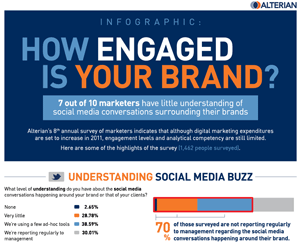
1. How engaged is your brand?

Here’s an interesting look at the opportunities the net has for your brand. This is not only nifty-looking, it has a number of elements that you can judge your own online efforts against.
It also offers a good reminder that anything you distribute on the net stays there forever. Your marketing strategies should all be designed to complement each other in building your brand’s presence on the web.


2. Modern Marketing/PR Fluency Matrix.
For all those small business owners and traditional PR pros, this will give you a look at where you might need to step up your Internet I.Q.
If you feel you’re lacking, subscribe to PR thought leader blogs, follow influencers on Twitter and stack resource books like The Social Media Bible next to your desk.

marketing-pr-matrix-small


3. All things Facebook.

This infographic is chock full of everything you could ever want to know about the social giant. Also, a good reminder that you should probably be leveraging this channel actively.
Go beyond collecting “likes” or “fans” and determine how this growing audience fits into your marketing objectives – don’t build a following just for the sake of popularity. Fine-tune your efforts to connect with the target audience for your brand.


4. Custom content distribution.

This infographic illustrates a streamlined approach to an effective content marketing campaign.
With content being the ultimate internet tool, this should spur you to find more ways to use your company news, news releases, helpful information and solutions to aid buyers in their decision-making.

content-dev-small


5. A Strategic Approach to Using Twitter.

If you haven’t considered all the ways Twitter can help your PR strategies whether connecting with journalists, prospects or both – this graphic is great to help you think beyond the tweet.
Incorporate the Follow, Create and Engage platform for all areas of your social media mix.
  • Follow thought leaders and your competition to stay on top of the latest news and trends.
  • Create content that is relevant and compelling.
  • Engage your target market with questions on your blog, participation in forums and production of webinars.
strategic-twitter-small
Seeing information in a whole new way is a great way to stir your creative juices.

When contemplating your own PR efforts, why not try inventing your own infographic? You may not only come up with a whole host of new ideas, your creation might just be the new darling of the infographic craze.

German agency accuses Iran of trying to buy nuclear technology after 2015 deal


High quality global journalism requires investment. Please share this article with others using the link below, do not cut & paste the article. See our Ts&Cs and Copyright Policy for more detail. Email ftsales.support@ft.com to buy additional rights. http://www.ft.com/cms/s/0/9739d5c0-4449-11e6-9b66-0712b3873ae1.html#ixzz4Dldjom1V
Iran has attempted to acquire nuclear technology in Germany even after the atomic accord it reached with western powers in Vienna last July, according to the German domestic intelligence agency.
The annual report of the Bundesamt für Verfassungsschutz (BfV) said that illegal Iranian attempts to procure technology “continued on a quantitatively high level by international standards” in Germany in 2015.
High quality global journalism requires investment. Please share this article with others using the link below, do not cut & paste the article. See our Ts&Cs and Copyright Policy for more detail. Email ftsales.support@ft.com to buy additional rights
High quality global journalism requires investment. Please share this article with others using the link below, do not cut & paste the article. See our Ts&Cs and Copyright Policy for more detail. Email ftsales.support@ft.com to buy additional rights. http://www.ft.com/cms/s/0/9739d5c0-4449-11e6-9b66-0712b3873ae1.html#ixzz4Dle24dXm
“This was particularly the case for merchandise that could be deployed in the field of nuclear technology,” the report said. There was also an increase in Iranian efforts to buy parts for missiles that could be fitted with nuclear warheads, it added.
In last year’s landmark agreement, Iran agreed to roll back its nuclear programme in exchange for the lifting of western economic sanctions, ending a 12-year stand-off with the west. So far, the signs are that Iran has kept up its side of the bargain, shipping thousands of pounds of enriched uranium — almost all of its stockpile — to Russia and deactivating its heavy water reactor at Arak.
In January, the UN nuclear watchdog certified that Iran had fulfilled its initial commitments under the agreement and some sanctions were lifted as a result — although Tehran has complained that it has not received the economic benefits it was initially promised.
Tehran has always insisted that its nuclear programme was for peaceful civilian means. Iranian officials could not be contacted for comment on Thursday, a public holiday in the Islamic Republic.
The disclosures by the BfV will be welcomed by opponents of the nuclear deal, such as Israel, which says Iran cannot be trusted to give up its ambition of building an atomic bomb.
A more detailed assessment of Iran’s activities in Germany was contained in the annual report of the BfV in North Rhine-Westphalia, Germany’s most populous state, which was published on Monday.
It said that counter-intelligence agents had recorded 141 attempts to acquire technology for “proliferation” purposes in 2015 — nearly twice as many as in the previous year. Two-thirds of these — or nearly 100 — were traced to Iranian entities.
But the report said Iran’s main focus was to procure parts for its missile programme, rather than for nuclear purposes. German officials have used that detail to stress that Iran is not necessarily in violation of last year’s nuclear accord.
“The agreement with Iran was about nuclear capabilities,” said one. “It has nothing to do with the ballistic missiles that Iran is in possession of
 

High quality global journalism requires investment. Please share this article with others using the link below, do not cut & paste the article. See our Ts&Cs and Copyright Policy for more detail. Email ftsales.support@ft.com to buy additional rights. http://www.ft.com/cms/s/0/9739d5c0-4449-11e6-9b66-0712b3873ae1.html#ixzz4DleCBB74
Neither report gives a breakdown of how much of the 2015 activity took place before or after the summer deal, but they make clear that some attempts to acquire equipment were made after July.
A UN resolution agreed as part of the July deal called upon Iran not to carry out work on missiles designed to deliver nuclear weapons. In March, Iran provoked Israeli protests after its Revolutionary Guard conducted a new round of ballistic missiles tests.
The BfV in North Rhine-Westphalia said Iran often targeted so-called “dual-use” technology that could be used for both civilian and military purposes. It said Iranians, as well as other “proliferation” states such as Pakistan, were acquiring merchandise under the pretext of “deploying it in civilian research, or in the oil, gas and steel industries”, and were often using “forged end-use certificates, or other seemingly official documents”.
The BfV also said that Iranian agents often used front companies in countries such as the United Arab Emirates, Turkey and China to conceal the final destination of the merchandise.
Volker Beck, a German MP from the opposition Green party who is also chairman of the German-Israeli Parliamentary Group, said the BfV reports were disturbing. “If we can ensure that Iran is not trying to obtain nuclear weapons, then last year’s deal with Tehran is a success,” he said. “But if the agreement is not working then that presents a big danger for the security of the region, of Israel, and of Germany.”
Additional reporting by Stefan Wagstyl
.”
.

Will Americans elect a 'congenital liar' president?


Does Hillary Clinton possess the integrity and honesty to be president of the United States? Or are those quaint and irrelevant considerations in electing a head of state in 21st-century America?
These are the questions put on the table by the report from FBI Director James Comey on what his agents unearthed in their criminal investigation of the Clinton email scandal.
Clinton dodged an FBI recommendation that she be indicted for gross negligence in handling U.S. security secrets, a recommendation that would have aborted her campaign. But Director Comey dynamited the defense she has been offering the country.
Comey all but declared that Clinton lied when she said she had State Department approval for the email server in her home.
He all but declared that she lied when she said she had only one server, and that no classified or secret material was transmitted. He also implied that she lied when she said she had used only one device and had turned over all of her work-related emails to State. The FBI found “several thousand” more.

Clinton said her emails were stored in a secure area. This, too, was false. Hostile actors and hostile regimes, said Comey, had access to email systems of those with whom she communicated.
Comey said he found no criminal “intent” in what Clinton did.
Yet, he charged her with having been “extremely careless” with U.S. national security secrets, a phrase that seems synonymous with the gross negligence needed to indict and convict.
While recommending against prosecution, Comey added, “This is not to suggest that in similar circumstances, a person who engaged in this activity would face no consequence. To the contrary, those individuals are often subject to security or administrative sanctions.”
Translation: Were Clinton still the secretary of state and were such recklessness with secrets to be discovered, she could have been forced to resign and stripped of her security clearance forever.

Yet if Clinton is elected president, our commander in chief for the next four years, and her confidantes Huma Abedin and Cheryl Mills, will all be individuals the FBI has found to be reckless and unreliable in the handling of national security secrets.
We will have security risks running the armed forces of the USA.
Nor is this the first time Clinton’s truthfulness has been called into question. Twenty years ago, she fabricated a tale about crossing a tarmac in Bosnia “under sniper fire,” and running with “our heads down.” Photos showed a peaceful arrival featuring a smiling little girl.
Family members of the dead heroes of Benghazi’s “13 Hours” say Clinton told them she would see to it that the creator of the anti-Islamic video that incited the mob that killed their sons would be run down, all the while knowing it had been a planned terrorist attack.
In 1996, the New York Times’ William Safire went over all of the statements Clinton had made in Whitewater and related scandals of Bill Clinton’s first term, compared them with subsequently revealed truth, and pronounced Hillary Clinton a “congenital liar.”
She has claimed she tried to join the Marines in 1975, and long contended she was named for famed mountaineer Edmund Hillary, who conquered Mount Everest. Only Sir Edmund climbed Everest when Hillary was 6 years old. The perfect running mate for this serial fabricator would be the Cherokee lass Elizabeth Warren.
Still, a question arises as to Comey’s motives in airing the findings of an FBI investigation. Normally, the bureau passes on the evidence it has found, along with its recommendation, to the Justice Department. And Justice decides whether to prosecute.
Like the reporting you see here? Sign up for free news alerts from WND.com, America’s independent news network.
Instead, Comey called a press conference, documented the charge that Clinton was “extremely careless,” contradicted, point by point, the story she has told the public, then announced he was recommending against prosecution.
What was behind this extraordinary performance?
By urging no prosecution, but providing evidence for a verdict of criminal negligence in handing classified material, Comey was saying:
I am not recommending prosecution, because, to do that, would be to force Hillary Clinton out of the race, and virtually decide the election of 2016. And that is my not decision. That is your decision.
You, the American people, should decide, given all this evidence, if Clinton should be commander in chief. You decide if a public figure with a record of such recklessness and duplicity belongs in the Oval Office.
Comey was making the case against Clinton as the custodian of national security secrets with a credibility the GOP cannot match, while refusing to determine her fate by urging an indictment, and instead leaving her future in our hands.
And, ultimately, should not this decision rest with the people, and not the FBI?
If, knowing what we know of the congenital mendacity of Hillary Clinton, the nation chooses her as head of state and commander in chief, then that will tell us something about the America of 2016.
And it will tell us something about the supposed superiority of democracy over other forms of government.